🌀 Vibe Coding Costs More Than You Think (Here’s the Calculator)
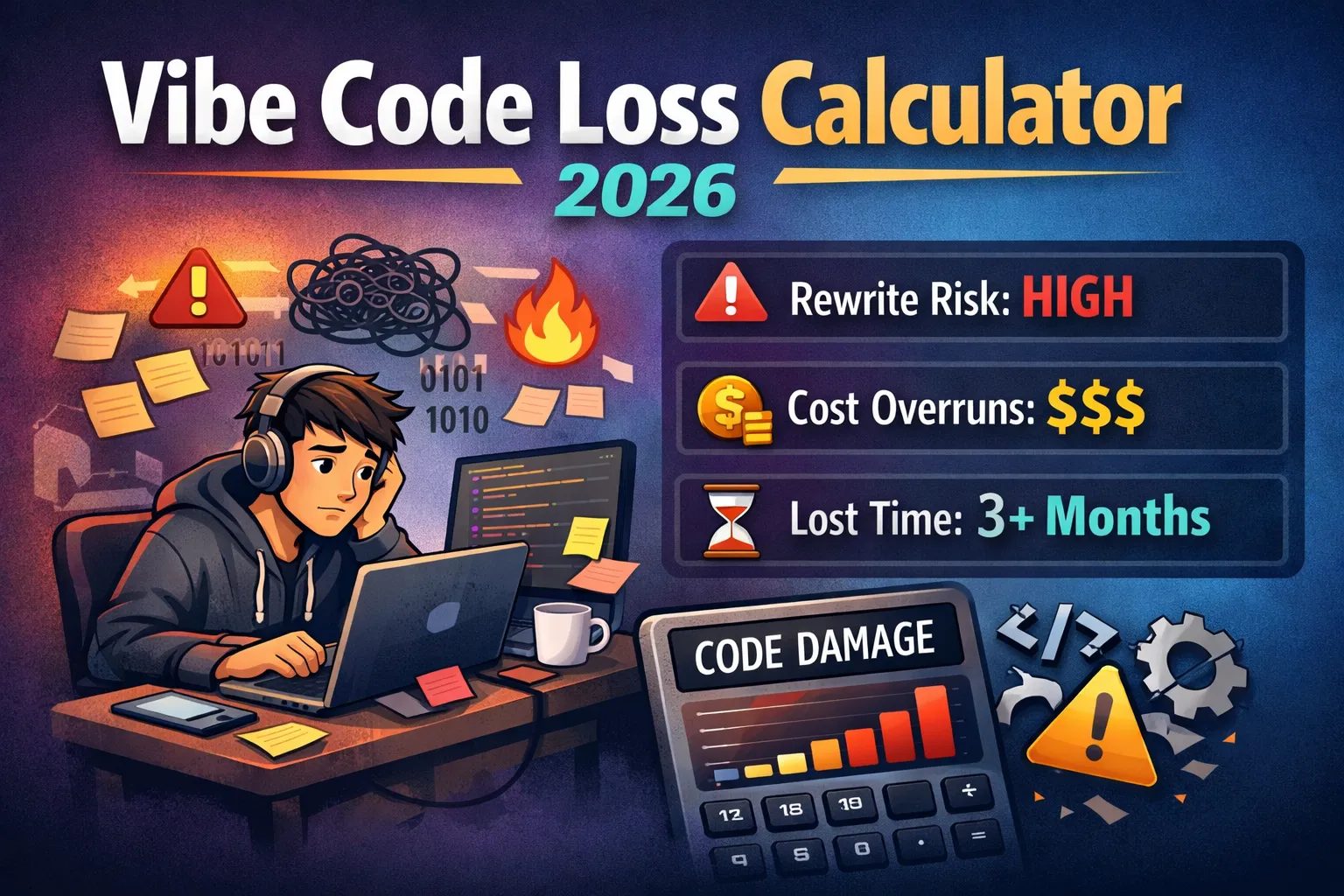
(AI can get you to a demo fast. It can also quietly delay your launch by months.)
👉 The calculator is retired. Explore the App Rescue Assessment
🧠 Who This Is For
If you’re a founder or product owner using AI tools to build an MVP in 2026, this is for you.
You probably already feel the pattern:
- You got a demo working fast.
- It looks like an app.
- Then you tried to add “real” features and everything got heavier.
- Then you added another developer and it got worse.
- Then you started hearing the word rewrite.
That’s not because you’re doing something wrong. It’s because the lifecycle stage changed — and the code didn’t.
✅ What Vibe Coding Gets Right
Vibe coding is incredibly good at:
- Rapid prototypes
- Throwaway demos
- Validating an idea cheaply
- Helping non-technical founders get momentum
When used intentionally (as a prototype tool), it’s a superpower.
⚠️ Where It Quietly Breaks
The cost isn’t in the first version. It’s in what happens next.
Once you move past “it runs,” the product starts to require things that don’t show up in a demo:
- Authentication that survives real users
- Data models that don’t collapse under edge cases
- Retries, failure handling, and background jobs
- Mobile state + lifecycle stability (especially iOS/Android)
- Security, auditing, and basic operational sanity
These aren’t features. They’re structural realities.
📉 The Second-Order Cost Curve
The hidden cost of vibe coding is second-order effects:
- Work that looks done but can’t be safely extended
- Coupling between UI, state, and backend that nobody can explain
- “Small” changes turning into multi-day regressions
- Senior engineers spending time untangling instead of building
🧠 Why Founders Underestimate This
Most founders model features, not behavior.
A demo can appear complete because demos don’t stress the system. Production does.
AI tools accelerate output. They don’t automatically create ownership, constraints, or architecture. Those still require senior judgment.
🧮 The Vibe Code Loss Calculator
To make this concrete, I built a calculator that estimates:
- Hidden cost already absorbed through delays and rewrites
- Rewrite probability based on project signals
- Severity and “rewrite pressure” indicators
- Estimated rewrite effort for senior-led recovery (if needed)
It’s not exact. It’s directional — and that’s usually enough to make a better decision earlier.
👉 Calculator retired: view the App Rescue Assessment
🧨 Why “Just One More Rewrite” Is a Lie
Most rewrites don’t fail because engineers aren’t good enough. They fail because the same governance failures repeat: unclear ownership, drifting scope, and committees making technical decisions without absorbing consequences.
A rewrite resets velocity to zero. It also resets trust. Founders underestimate the emotional and operational cost of that reset — especially if users are already depending on the system.
The harsh truth is: most teams don’t need “a rewrite.” They need a single owner, a scoped pilot, and constraints that stop entropy from entering the codebase in the first place.
✅ When Vibe Coding Is Safe vs Dangerous
✅ Safe
- Disposable prototypes
- Internal demos
- Throwaway experiments
- No compliance or operational risk
⚠️ Dangerous
- Real users
- Revenue
- Multiple developers touching everything
- No tests, no data model, no technical owner
- Any domain where failure has consequences (healthcare, ops, finance)
💬 Vibe Coding FAQ (2026)
❓ Is vibe coding always bad?
No. It’s great for prototypes. It becomes expensive when teams treat
prototype code like production systems.
❓ What causes projects to fall into the “vortex”?
Usually: unclear ownership + scope drift + multiple contributors +
missing guardrails (tests, data contracts, failure handling).
❓ Can a senior engineer fix a vibe-coded app?
Often yes — but it depends on the stage. Recovery is usually measured in
months, not hours, once real users and operational risk exist.
❓ What’s the fastest way out?
Clarify ownership. Freeze scope. Stabilize the pilot path. Then harden
the system incrementally. Most “quick rewrites” fail because those steps
don’t happen.
🤝 If You Want a Real Answer
I’m not anti-AI. I’m anti-fantasy. If you’re past the demo phase and unsure what to do next, a short architectural review usually saves far more than it costs.
👉 Book a technical reality check
✅ Final Thought
The goal isn’t to code slower.
The goal is to prevent “fast” code from turning into “expensive” code.
The earlier constraints exist, the less likely you’ll ever need a rewrite.