Why Your “Almost Working” App Never Gets Released
Most apps don’t fail because they were a bad idea. They fail because they stopped at “almost working.”
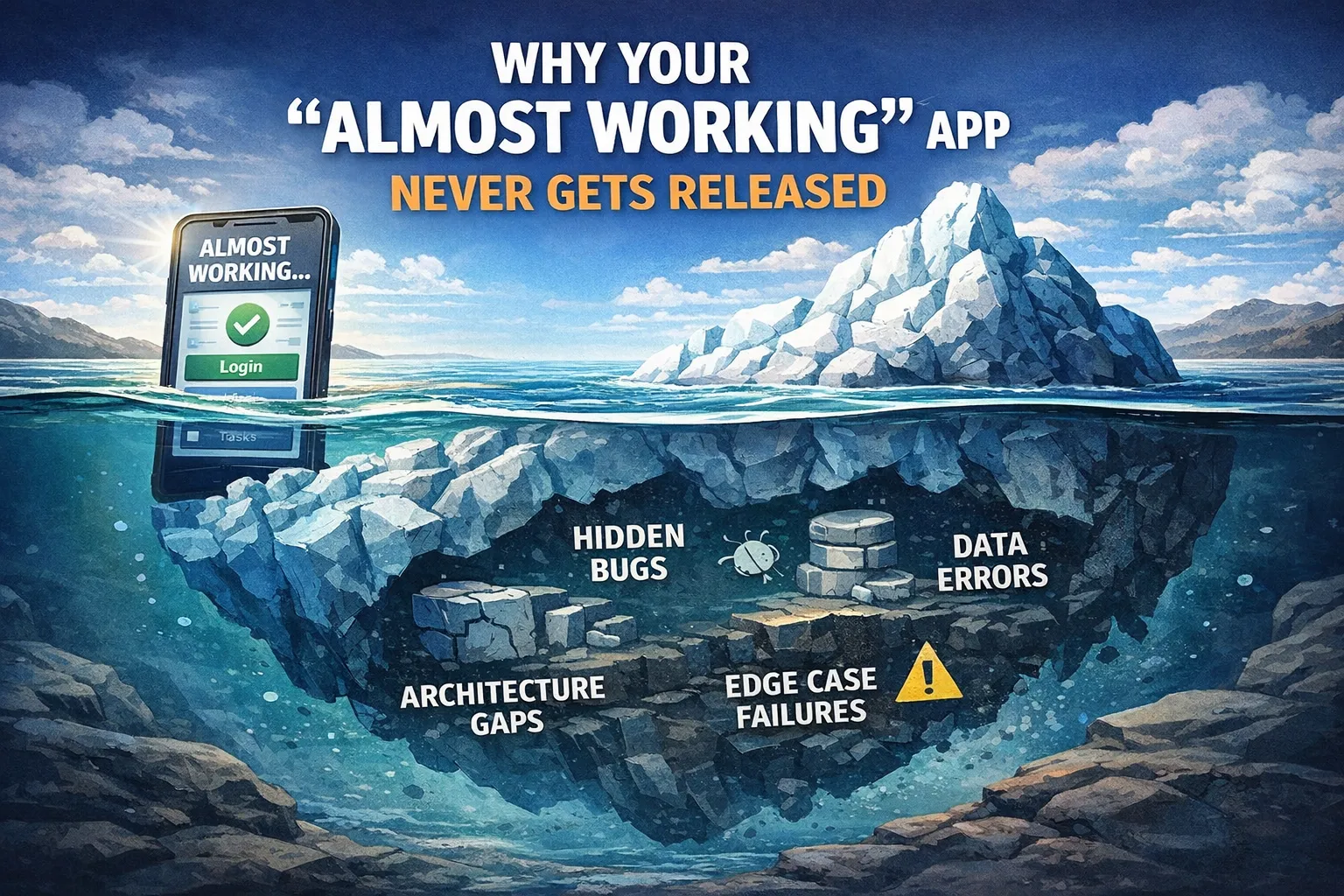
The “Almost Working” Stage
There’s a pattern I see over and over again.
An app gets built. It works — mostly.
- You can log in
- You can click around
- Core features exist
- The idea is visible
It feels close.
But it never gets released. Or it gets released and immediately runs into problems.
It’s not broken. But it’s not stable.
And that difference is everything.
What’s Actually Happening
At this stage, most people think:
“We just need to fix a few bugs.”
That’s not what’s happening.
What’s actually happening is:
👉 the system is revealing parts of itself that weren’t understood during development
Software Doesn’t Reveal Itself Upfront
You don’t start with full understanding.
You start with an idea. Then you build.
Then reality shows up:
- hidden dependencies
- edge cases
- timing issues
- data inconsistencies
- architectural gaps
This is not failure.
This is how software works.
“Almost Done” Is Where the Real Work Starts
Early development feels fast:
- features get built
- UI comes together
- things appear functional
But finishing is different.
This is where:
- systems must behave consistently
- data must be correct
- edge cases must be handled
- everything must work together
That’s not polishing.
That’s the system becoming real.
Why Cheap Development Feels Like Progress
Many teams can get you to “almost working.”
That’s the visible part:
- screens
- buttons
- basic flows
It looks like progress.
But it doesn’t solve:
- system stability
- data integrity
- real-world behavior
So you end up with something that looks done but isn’t usable.
The Investment Gap
This is where most projects fail.
Not because they were impossible.
But because:
👉 the cost of getting from “almost working” to “actually usable” was underestimated
The Question That Breaks Everything
At some point, someone asks:
“Are you going to finish this if I keep paying you?”
That question sounds reasonable.
But it’s flawed.
It assumes:
- the problem is fully understood
- the boundaries are known
- the effort is predictable
None of that is true at this stage.
There is no clean answer to that question.
The Only Honest Model
The real process looks like this:
- You start digging
- The problem expands
- You uncover what’s underneath
- You build understanding
- The system stabilizes
- You resolve it
That expansion phase?
👉 That is the work.
The Real Decision
The question is not:
“How long will this take?”
The real question is:
👉 “Am I willing to keep working through this?”
Final Thought
Software isn’t something you finish.
It’s something you:
- build
- stabilize
- improve
- commit to
If your app is “almost working,” you’re not close to done.
You’ve just reached the point where the real work begins.
One-line version
“Almost working” isn’t close to done — it’s where the system finally starts revealing itself.